

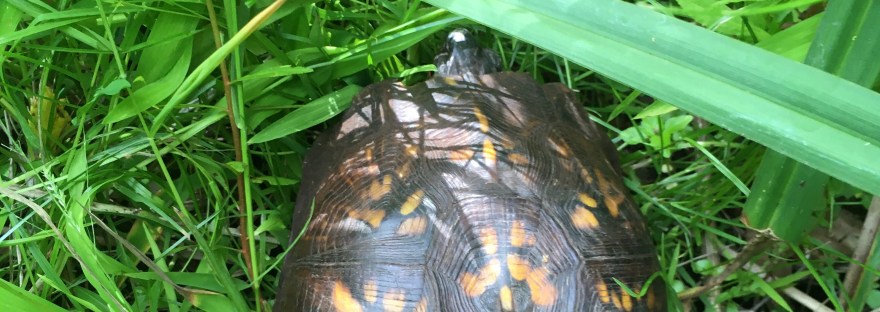
I recently came across a really interesting study being done by the TSA (Turtle Survival Alliance) & Tangled Bank Conservation, which is seeking to use DNA to map populations of eastern box turtles. The goal of the project is to create a DNA database of known turtle populations so that when confiscated turtles/turtles of unknown origin are taken in by authorities, that turtle’s DNA can be compared with the database to figure out where it came from. Then, once appropriate health/disease checks are complete (the PARC Disease Task Team is working on coming up with guidelines for this), it can be repatriated to the wild.
Here’s a video from the TSA’s virtual Symposium last year that explains it (it’s only 15 minutes long):
https://www.youtube.com/watch?v=WAd8LEqDgDo
The main person in charge of the study is JJ Apodaca, who has served as a national chair for PARC (Partners in Amphibian & Reptile Conservation), so you know he’s legitimate. Here’s his email: JJ@tbconservation.org
Why am I telling you all this? They are building this database and they need more data.
While it is illegal and has been for some time to take box turtles from the wild to be pets, I’m sure that some people who might be reading this have illicit boxies that they know exactly where they picked it up from, maybe decades ago, and brought it home to keep for a pet. While there isn’t really a clear path back to the wild for most once-wild captives (and most pet turtle owners would shudder at the thought of giving up their box turtle), those illegal pets could help pave the way for the victims of future poachers (who steal large numbers of turtles to sell illegally for profit) to find their way back home. I’m certainly NOT encouraging anyone to go out and find box turtles specifically to take samples, because that is illegal too without the proper permits, even if it’s for a good cause and you aren’t actually keeping them or taking them out of their habitat. But if someone already has a turtle in their possession, and their contribution could help repatriate turtles from mass seizures get back to the wild, then at least there is some good there.
Also, it’s possible other rehabbers will see this, and I encourage you to contact the scientist in charge of the study and find out about donating your own patients’ DNA to the database.
I would love it if turtle rehabbers such as myself would be recommended by the DEEP officially to submit DNA samples from our box turtle patients to the study, to help map box turtle distribution and ultimately aid in creating a confiscation-to-repatriation pipeline for struggling turtle species. It wouldn’t cost the state anything if we contacted them directly, as they would mail out DNA sampling kits and instructions for free to the rehabber requesting them. Rehabbers would only be paying return postage (not that we need any more expenses, but a few dollars for postage is a drop in the bucket of rehab costs for most of us, and worth it, in my opinion, if it can help confiscated box turtles go back where they belong). I especially like having this as an option when a turtle doesn’t make it. It feels like such a waste and a tragedy when a patient dies, but there is some solace in knowing that a DNA sample taken from it may help its future brethren get back home.
I know that knowing the location of origin is only one piece of the puzzle, but solving that one piece could still do a lot to help wild turtles. Rehabbers and other responsible turtle folks may have some questions about this venture, and I contacted JJ Apodaca myself to ask what I thought people would want to know. Here are the answers, summarized/paraphrased below:
1 – How do you keep location information safe? How do you verify requests for information to make sure someone isn’t just trying to find out where these turtles live so they can go poach them (as I’m sure you’re aware, many crowd-sourced wildlife ID apps and citizen science initiatives have run into this same problem). At the same time, how do you balance safety/security of location information with getting that info out to the people who need information to complete reintroduction?
We have a secure server offline where the data is stored. So far, we only respond to government agencies trying to determine where an individual came from. In general, this technique will never be accurate enough to give away a specific location, but rather it can tell us generally where an individual should be returned. Think county and not specific spot.
(My note: Theoretically, agencies would have known locations of box turtle colonies stored securely somewhere and getting a county would help them narrow down possible habitat ranges.)
2 – Is your research database currently at the point where you could process a sample of box turtle DNA from an unknown location and provide an accurate habitat location for it? If so, how does one go about requesting such a service and how much would it cost? If not, when do you anticipate that your data would be complete enough to be able to do this?
We probably need another year or two to get to that point for box turtles, though other species are at this point now.
3 – Are you still in need of box turtle DNA samples from our state (Connecticut)? Are there any places you are currently more in need of samples from than others?
Yes, Connecticut is definitely a state of need. There are for sure. Pretty much all of the North East is an area of need.
4 – I know you can send out a few kits here and there for sample collection for free, but if you were processing many from the same state, can we expect to still be able to contribute at no cost aside from return postage?
Those are currently paid for by a donor who is funding the database getting built. At some point those funds will run out and we will have to find other funds to do the work, whether that’s charging or an agency pays.
5 – Do you anticipate this research/DNA database to be a continuous effort, or is there an expiration date on this potentially very valuable tool?
This will be a continuous effort. For something as wide-ranging and numerous as box turtles, it’s going to be a never ending project that just gets more effective over time.
He also said he’s happy to answer any more questions and to be contacted by state officials who might want to work together to help box turtles. (I’ve already contacted mine, who haven’t responded to me, likely being very busy as under-funded environmental agencies tend to be, so that’s another reason I’m just spreading the word here.)
This kind of scientific work is more than theoretical, too. Here is a story from earlier this year about this same scientist’s work with a different species, the alligator snapping turtle, which was able to be repatriated after being confiscated by authorities from poachers who had stolen more than 2 dozen animals from the wild in Texas.
In our area, they recently expanded the database building to include bog turtles, another endangered species. I haven’t had one of these as a patient yet, which I’m hoping is a good thing, because they are very rare and elusive. But if you have a box or bog turtle in your possession that came from the wild and you know exactly where, please consider contacting JJ Apodaca and contributing to this database so you can help future turtles.

 Turtle Haven
Ohh wow – I really hope this helps get turtles home. Thank you for sharing this!
Btw Toni the YBS is doing just fine – thank you for all your help and advice!
Suzanne
LikeLike
This is really interesting and I hope the DNA project is able to help many turtles.
LikeLike