
Most likely, call a rehabber, but it’s not always necessary, and sometimes there’s a different expert you should call. Click the image below to enlarge it and follow the steps to figure out what you should do.
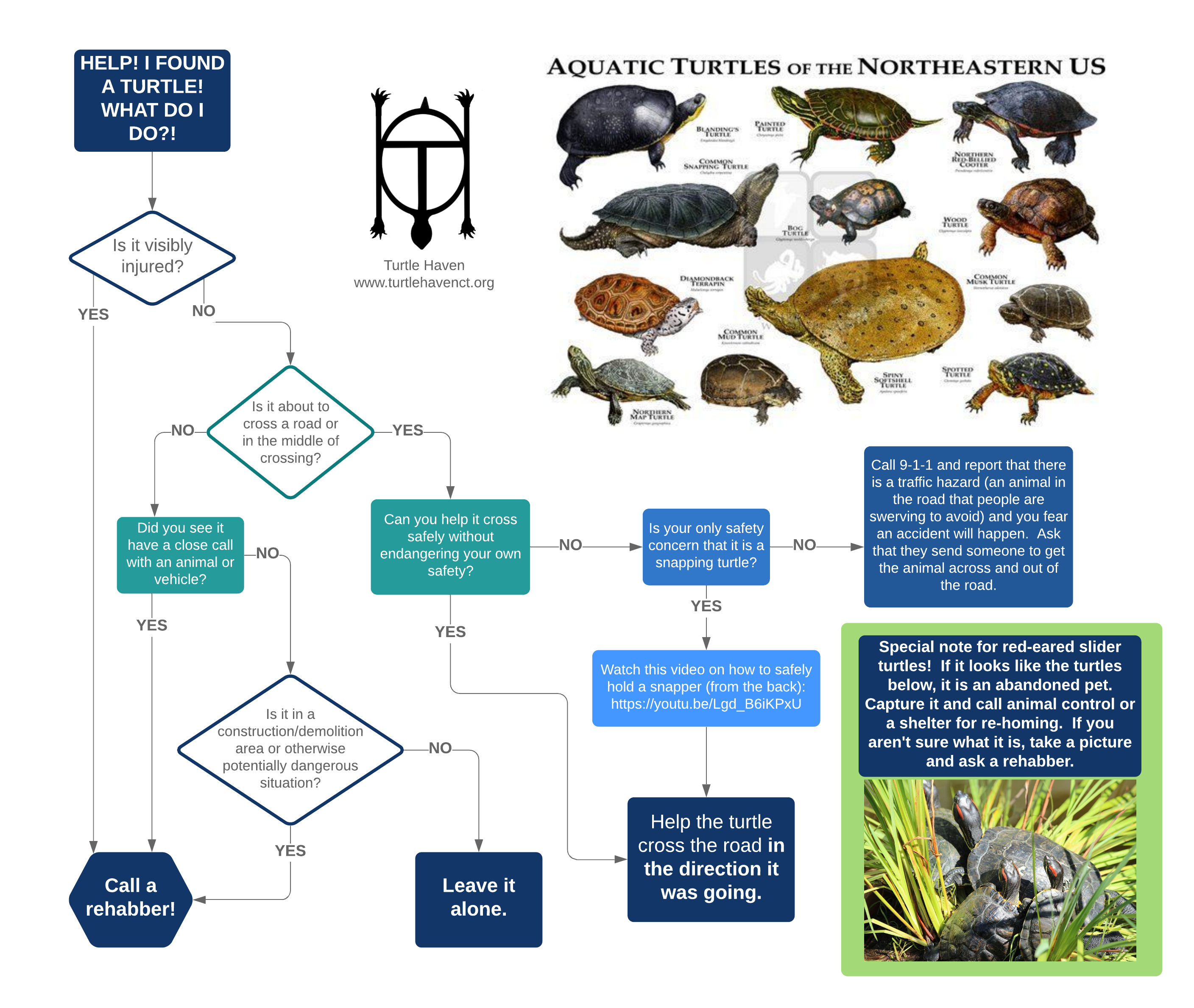
If you want a more detailed description of why you take each step, please keep reading. If you’re in an urgent situation, though, just follow the chart first and come back here later.
How do I contact a rehabber?
How to find a rehabber near you: If you’re in Connecticut, click here for a list of turtle rehabbers by town. You may also want to call their wildlife dispatch number (860-424-3333) if you can’t reach a rehabber. Outside of Connecticut, just google “wildlife rehabber + [your state]”. Your local department of energy and environmental protection should have its own page about dealing with distressed wildlife/how to find a rehabilitator.
Is it visibly injured?
Path 1: Yes
Call a rehabber. Pretty simple. How to find a rehabber near you: If you’re in Connecticut, click here for a list of turtle rehabbers by town. Outside of Connecticut, just google “wildlife rehabber + [your state]”. Your local department of energy and environmental protection should have its own page about dealing with distressed wildlife/how to find a rehabilitator.
Path 2: No
Turtles hit by cars or on the side of the road are the most common way people find them in need. Catastrophic injuries visible while driving require immediate attention, but what may look like a healthy turtle could be injured in smaller ways, so give it a good once-over to make sure it doesn’t need medical help first. Once you’re sure it doesn’t need help medically, move on to the next question.
Is it about to cross a road or in the middle of crossing?
Path 1: No
If it’s not crossing a road, the turtle probably doesn’t need your help, and the best thing to do is to leave it alone. However, there are other dangers besides roads, so please continue to the next question.
Path 2: Yes
The goal here is to get it safely across the road, in the direction it was going. If you turn it around and put it back where it came from, it will just try to cross again later and might not be lucky enough to cross unscathed or be noticed by someone who wants to help. However, don’t get yourself killed in the process. If it is safe for you to stop and help the turtle, please do so. For all turtles except snapping turtles, the best way to do this is to grab their shells at the middle on either side, where its waist would be if it had one, between the front and back legs. They may try to bite because they don’t know you’re trying to help, but they can’t reach to their waist, so you’re safe there. Their back legs do still have claws, though, and those they may use to try to claw you if they’re really freaked out, but most likely, they’ll just retreat into their shell. If you do get scratches from turtle claws while helping, it’s okay. Just wash your hands or use sanitizer as soon as you get a chance and don’t stick your hands in your mouth or eyes until you do so…the same as you’d do for any minor scrape.
If you’re worried about the turtle biting you because it’s a snapper (they’re the big, gray ones with spiky bits on their tails which makes them look like dinosaurs), you can still help it cross safely. Instead of grabbing by the waist, grab further back on the shell, just above the back legs on either side. Their shell shape is unique in that there are practically handles there, which other turtles don’t have. Just grab by those back handles and carry it across the road. The snapper’s neck doesn’t reach all the way back there (but don’t be startled if it tries to anyway…you’re safe, I promise). If the snapper is too heavy to carry, put it on the little foot rug/car mat from the driver’s or passenger’s floor and use that to drag the turtle across the road. There is a really great video of how to help snapping turtles across the road here.
One thing that is true of all turtles you are trying to help cross the road is that you should NEVER pick a turtle up by its tail, legs, head, or anything other than its shell. Doing so can sever its spinal cord and/or dislocate joints, leaving the turtle paralyzed. And you don’t want that. You’re a caring person who’s trying to help the turtle, not hurt it.
Now, if you see a turtle and want to help it but you’re on a busy highway and it’s not safe to walk across a road or even stop for it, the time has come to get the police involved. It may seem ridiculous to call 9-1-1 over a turtle, but if a turtle or any other animal is trying to cross a busy highway, it’s not just putting itself in danger (though it is in more danger than anyone else in this situation). People who see the animal trying to cross may try to swerve around it or brake hard to not hit it, which may cause another car to plow into them or them to hit another car. At this point, an animal in the road is an emergency for people as well, because it is creating a traffic hazard. If you call 9-1-1 and explain it this way, they will (or at least, should) send somebody to safely stop and divert traffic long enough to help the animal cross.
Did you see it have a close call with an animal or vehicle?
Path 1: Yes
If you didn’t see it get hit by a car, but it looks like it was just missed by a car, or if it has made it to the other side of the road (its tail is facing the road and it is walking away from a road), you should still check on it if you can do so safely. It may actually be injured and you can’t see it from far away. Also, if you see an animal grab it and immediately put it down, it may still have sustained injuries, even if it immediately starts walking away. In any of these situations, the best thing to do is call a rehabber.
How to find a rehabber near you: If you’re in Connecticut, click here for a list of turtle rehabbers by town. Outside of Connecticut, just google “wildlife rehabber + [your state]”. Your local department of energy and environmental protection should have its own page about dealing with distressed wildlife/how to find a rehabilitator.
Path 2: No
If it isn’t in immediate danger, the turtle may still be in distress and need help. If you find a turtle of any kind in a construction or demolition area, it most likely lives there, and people are planning to or are in the process of destroying its home. It is unlikely to survive all the equipment thundering around, and even if it does, it will have a hard time finding a suitable habitat, which may be miles away from the one people are demolishing. In this case, call a rehabber, because they will be able to find a suitable habitat to relocate the animal. Do not just grab it and throw it in the nearest stream or pond. Different turtle species have different habitat needs, and a rehabber will be knowledgeable about where the best ones are that meet its needs for food, shelter, and breeding.
How to find a rehabber near you: If you’re in Connecticut, click here for a list of turtle rehabbers by town. Outside of Connecticut, just google “wildlife rehabber + [your state]”. Your local department of energy and environmental protection should have its own page about dealing with distressed wildlife/how to find a rehabilitator.
If none of these scenarios are the case, the best thing you can do for the turtle is to leave it alone. Proceed to the next section.
When should I report a healthy, happy turtle?
If a turtle is endangered, threatened, or of special concern, the DEEP wants to know about it. However, they don’t make it super-easy to find this information out, nor do they make reporting very intuitive. So, I’ve gone through their cumbersome and disorganized website to find the most relevant information and linked it below. This is just for Connecticut residents. For other states, you’ll have to consult your own DEEP’s website.
What turtles are endangered, threatened, or of special concern in Connecticut?
The short answer is: most of them. Of the 12 turtle species that inhabit Connecticut, 9 are endangered (here, for brevity, I’m referring to any species listed as threatened or special concern or endangered as “endangered”). Even if you take out the ocean-going turtles which technically include Connecticut in their range but we are very unlikely to see, that leaves 8 freshwater turtle species, of which 5 are listed as endangered, threatened, or of special concern.
Here is a list of turtle species found in Connecticut.
Here is a list of endangered turtle species found in Connecticut.
The only native turtles NOT endangered right now are snapping turtles, painted turtles, and musk turtles. And even they are not really thriving so much as not on the brink of extinction at the moment.
Non-native turtles, like red-eared sliders, are considered invasive, because irresponsible pet owners illegally released them into the wild.
How do I report endangered wildlife?
Here is the DEEP’s page on how to report sightings of endangered wildlife. They want you to download and fill out a form and email it to them, along with pictures (if you have them). You may also want to call their wildlife dispatch number (860-424-3333) if you can’t reach a rehabber and one of the endangered species is in trouble. Turtles are considered vertebrates rather than aquatic species for reporting purposes, just so you know which form to use.
Why does the DEEP want to know about endangered wildlife?
They use this data from citizens to add to their official wildlife surveys in order to determine where endangered wildlife still lives in the state. This helps them decide where to allow people to build things. If the state doesn’t know an endangered animal or plant is living somewhere, they don’t know that they should deny a prospective builder access to destroy wild land. By adding your sightings, you increase the protection of not only that one species, but of all the other wildlife that lives in that same area. To get an idea of where endangered wildlife may reside near you, you may consult their eco-maps by town here. To be able to zoom in/out and move around, go to their interactive eco-maps here. You have to go to the “Simple Map Viewer” and then under “Layer List”, click “Habitat”, then “Natural Diversity Database Area”, then zoom in on an area and move around. It just tells you that there IS endangered wildlife in that area, not WHAT endangered wildlife is in the area, nor where exactly. The reason this level of detailed information is not publicly available is because people go out and illegally harvest lots of different native plants and animals, and this much information in the wrong hands would practically ensure the destruction of the species.
Is it a native turtle? (Side note on red-eared sliders)
Path 1: Unsure
If you’re not sure if it’s a native turtle or not, take a picture of it and text it to a rehabber and then call them. A rehabber will be familiar with what species are native and can help you figure out the next steps.
Path 2: No
If it’s not a native turtle, it’s not technically wildlife, but an escaped/abandoned/stray pet. When you think of stray pets, images of reptiles are probably not the first thing to pop into your head, but they’re more frequently abandoned than you might think. There is also the slim chance that somebody’s beloved turtle or tortoise in an outdoor enclosure dug or climbed its way out, and that person is actually missing it. Therefore, you want to give your local animal control a call and have them come pick it up. Someone may be looking for it, and even if they’re not, non-native turtles don’t belong in the environment. They’ll either die a slow and painful death from starvation/dehydration because they don’t know how to find food, get eaten by a predator, get hit by a car, OR, they’ll become invasive and push out native turtles by stealing resources and territory. If a rehabber takes in a non-native turtle, the DEEP requires it to be euthanized. Many rehabbers will try to find a person to adopt it before resorting to putting it down, but the reality is that rehabbers don’t have the resources to rehome every abandoned pet that comes their way. This is why you should call animal control instead. If they will not come out to take care of the turtle, then you should call a rehabber and explain the situation. Knowing you already tried to get Animal Control to deal with it, some rehabbers may take pity on the turtle and take it in, at least temporarily, and try to find a home for it.
Path 3: Yes
Native turtles are wildlife. Please leave it alone if it is not injured/in danger. Taking even one native turtle out of its habitat deprives the ecosystem of dozens of generations of new baby turtles, upsetting the delicate natural balance. There are many other, more responsible ways to get a pet turtle if you want one. Check out my Adoptions & Pets page for a list of places to look if you want to get a pet turtle. Adoption is always preferable to buying from a pet store or breeder, and there are tons of turtles in need of homes.
 Turtle Haven