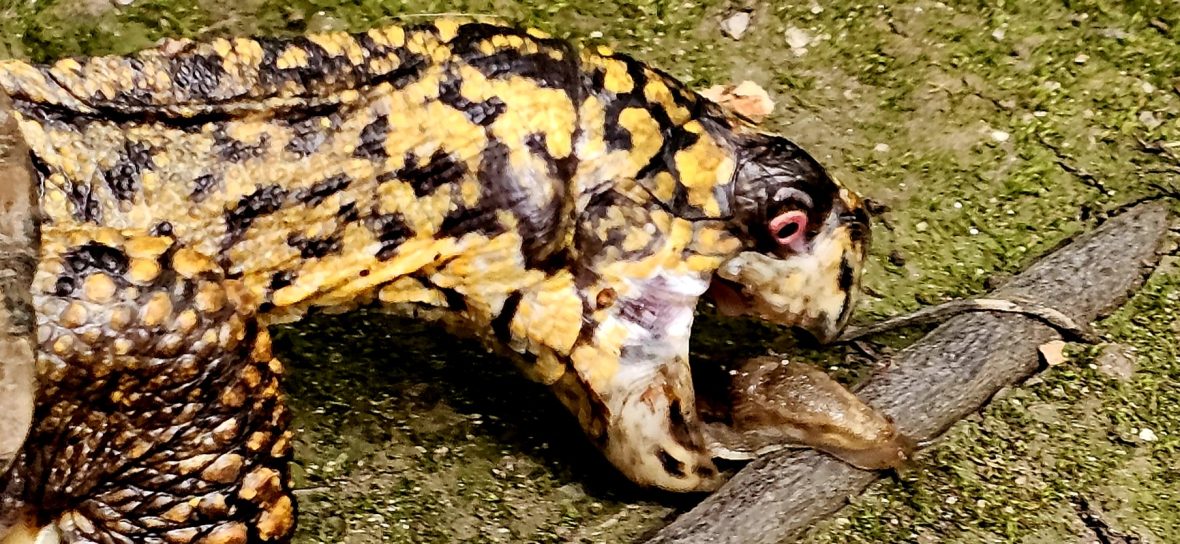

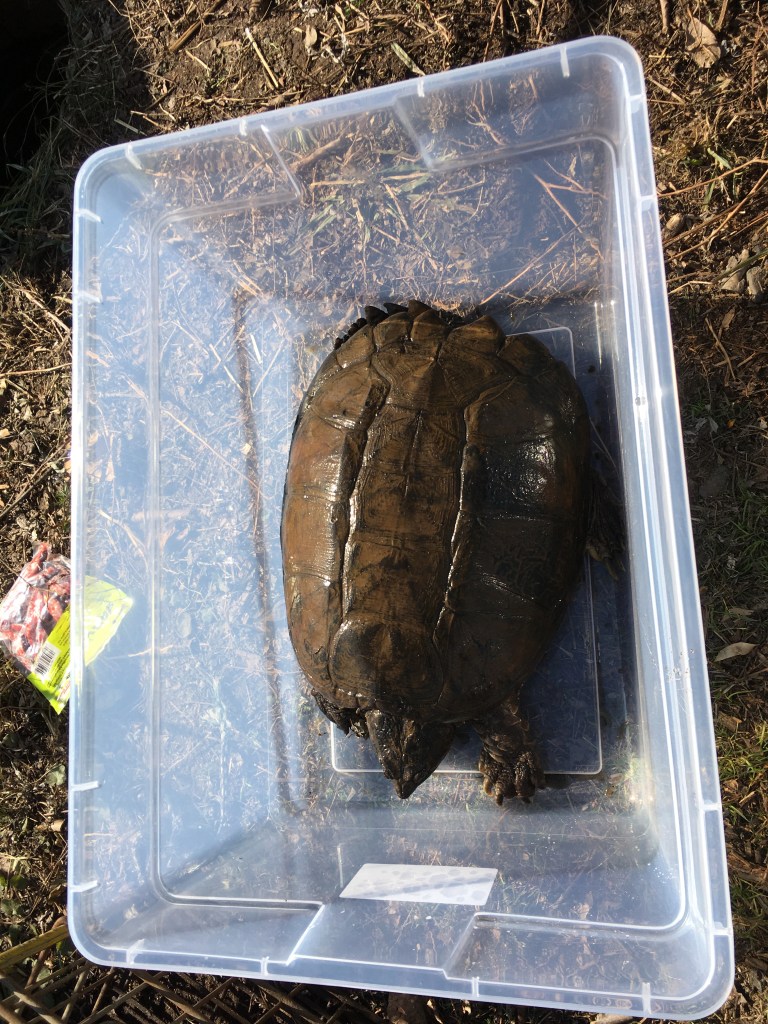
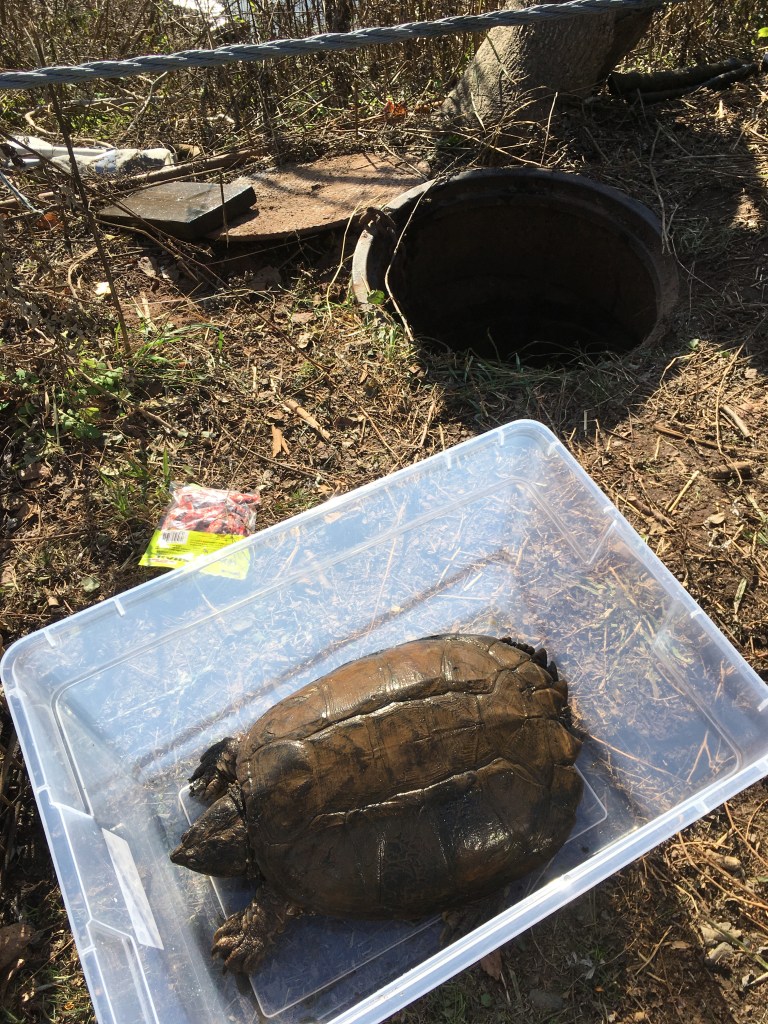
This big guy was rescued from certain death a few days ago after he fell down an open manhole at a golf course. Hopefully the workers there will remember to close it next time as soon as they’re done using it so that animals (or people) don’t fall in and get hurt, or worse.
Ideally, this guy should have been happily hibernating at the bottom of the pond, but the maintenance crew decided now was the time to drain the water, forcing this poor turtle out of hibernation in search of a full pond with enough muck at the bottom to burrow into.
Aquatic turtles don’t have a sense of drop-offs the way terrestrial turtles do, meaning, they can’t see a cliff or other sharp drop or hole, and will literally walk right over the edge without knowing it. Animals that spend most of their time in water don’t really need to perceive cliffs, so they never evolved that capability.
This turtle miraculously avoided impaling himself on a pipe sticking out from the bottom of the hole, but was extremely cold and lethargic from being in near-freezing water for several days before he was discovered and got help. He is currently recovering with fellow rehabber Pam (I’m in the middle of moving and don’t have the space/supplies for a big patient like this right now), and with antibiotics and supportive care, he has a good chance of recovering until spring when he’ll be released.
Wildlife have a love/hate relationship with golf courses. On the one hand, they often provide some semblance of natural resources in otherwise urban areas for animals to take refuge. On the other hand, constant “maintenance” and other human dangers pose increased risks to animals living there. There are things golf course maintainers and owners can do, however, to make their courses more eco-friendly. Study the impact of your maintenance schedule on wildlife (i.e. – don’t disturb habitat during critical times that will negatively impact hibernating or reproduction…like trimming trees in spring when birds are raising babies or draining ponds in autumn/winter when turtles are hibernating). Plant native plants on your “rough” or out-of-bounds areas and let them grow through their full life cycle without mowing or pesticide use. Monitor your sand traps for nesting behavior and call a rehabber to deal with inconveniently placed turtle eggs. Maintain pristine ponds through creating a balanced ecosystem rather than continually pumping the water with chemicals to control algae and bugs. Make sure safety protocols are being followed and things that could pose dangers to animals (or people) are addressed in a timely manner. A lot of these steps don’t take a lot of effort or money to do, and can even save money in the long run…plus, you get to brag about how “green” your green is!
There were a few things about this call that were disheartening. One is that the finder said they called the animal control officers for both towns that the property inhabits and neither could be bothered to respond because it “wasn’t their jurisdiction”. The ACOs just kept telling the finder to call the other town even after being told they already refused to come out. I feel like if you’re more worried about drawing a line in the sand than helping an animal in distress, you’re in the wrong career. Another thing was that only one person who worked there wanted to call anyone to help it for nearly a week. This turtle could’ve been suffering for a lot less time if I’d been called earlier (or if Animal Control had done their job and rescued it and then just handed it over to a rehabber for the rest of its care needs). Nobody would be arguing about jurisdiction if it was a child trapped in that hole. I don’t see why a different species’ innocent life is any less valuable.
Then, while trying to fish out the snapping turtle, we kept finding shells of multiple other long-dead snapping turtles of a variety of sizes…meaning this is a regular occurrence and continuous death trap for wildlife. And the icing on the shit cake was when one of the managers there said they always see turtles lay eggs in the sand traps and get eaten by raccoons the next day…and they called the turtles stupid for laying their eggs there! It’s not the turtle’s fault that human-subsidized predators are abundant in a human-altered habitat to the point where none of their offspring will survive. I did try explaining this, but I don’t think it really sunk in.
Raccoons, squirrels, and other common suburban and urban wildlife have bigger populations than they would in the wild because human habitat has made it easier for them to exist (usually due to an abundance of food in the form of trash, many extra nesting areas like in attics and under sheds, and also the destruction of quality nesting areas and other spaces for the larger predators who would normally hunt them). In a balanced ecosystem, these animals would still eat many turtle eggs, but there would be few enough mid-level predators and numerous enough turtles laying eggs so that at least some of them would survive. When people come in and change everything, it upsets that balance. Nearly all of the turtles native to Connecticut are listed as threatened or endangered, and even the “common” species are in decline. Humans subsidizing the survival of small and medium-sized omnivorous mammals puts other animal groups at risk.
One good thing about this encounter is that the finder seemed really gung-ho about helping the turtle and wanted to know more about what he could do for turtles, having a soft spot for them since he has them as pets. It’s always nice to meet someone who shares your enthusiasm for animals. In the spring, I’ll probably take him up on his offer to be a volunteer transporter.
Another good thing was my husband coming along to do the dirty work. I wish I took pictures of my husband Bobby actually in the hole, but I was too busy handing him tools and taking up trash that was getting in the way (and playing PR manager to bystanders)…but Bobby spent about an hour and a half fishing around in this manhole (after trying from the top wasn’t working), balanced on tiny pieces of pipe, trying to rescue the snapping turtle that was stuck down there on a 25º cold November morning (who did NOT want to be caught). There was no way in or out except the vertical 10-foot drop with only some of the built-in ladder rungs not rusted off. He put his parkour and ninja skills to good use and rescued a ~20lb snapping turtle from certain death.
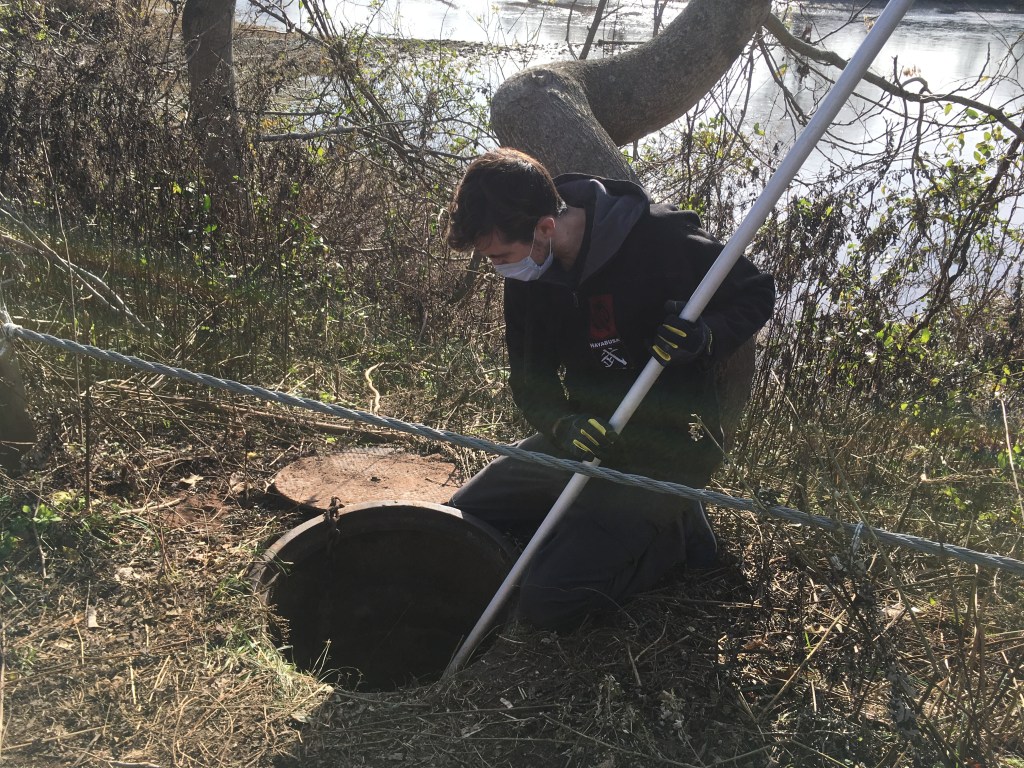
This is the kind of man you want to marry. One who will take time out of his day to rescue turtles with you. Honestly, I should start logging the hours he has voluntarily assisted with Turtle Haven business, because at this point, he’d probably have nearly enough to get his own rehabber’s license. He claims he doesn’t want to be a rehabber himself because then he’d have to deal with the public, and I can’t say as I blame him. Most of the time people are good, but sometimes their willful ignorance and bad attitudes can get on your nerves.

 Turtle Haven