

A couple of weeks ago, I went to a turtle rehab seminar put on my my mentor and her mentor, detailing turtles, start to finish. This is pretty much everything I’ll need to know that the regular certification class won’t teach me. I took six pages of notes, plus all the handouts, and it really answered a lot of questions I didn’t even know I had. I’m so glad that I went there. It’d be difficult to put down all the stuff that I learned, so I’m just going to list a few highlight a few things here.
Turtles are survivors. They can survive and heal from the most traumatic injuries that would kill most other animals, if they’re treated in time. They can survive up to 90% blood loss, crushed shells (as long as the spinal column is intact), organs hanging out (as long as they’re not punctured), broken bones, dehydration, and not eating for weeks…as long as they get to a rehabber in time.

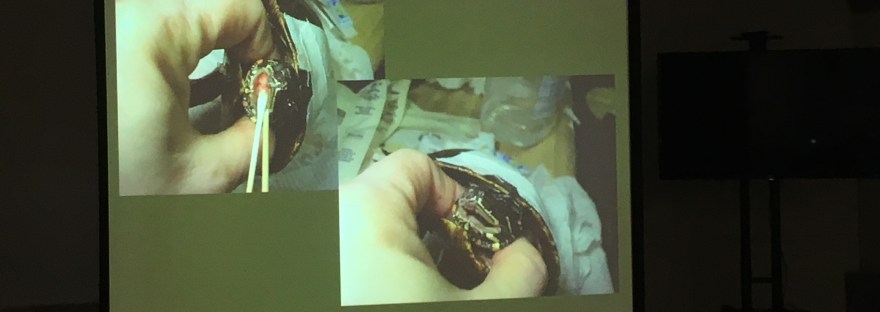
Time is critical. Most injured turtles are hit crossing a road, which puts them at increased risk for dehydration, blood loss, and further injury. However, the biggest threat an injured turtle faces between when it is hit and when it gets help is none of those things. Their biggest threat is actually quite small: maggots. Maggots are fly larvae. Flies are drawn to the smell of blood, and beyond their ability to spread disease, fly larvae will eat a turtle alive. Maggots eat dead flesh, it’s true, and any injury will have some dead flesh in there. However, the bugs aren’t picky, and when the dead flesh runs out, they’ll eat the live flesh too. Beyond that, their poop turns live flesh into dead, giving them even more to eat. Eggs can hatch in as little as 9 hours, and one fly can lay hundreds of eggs. What this means is that if you get a patient in with maggots on it, it is automatically an emergency and absolutely cannot wait. The turtle might not be there the next day; instead, all you’ll have is flies.

This is probably the grossest thing that I learned at the seminar, and really the only thing so far that has made me question whether I’ll be able to handle being a rehabber. I’m not especially squeamish when it comes to blood, or poop, and while I know I’ll be sad about it, I understand that eventually I’ll take in a turtle that I can’t save. None of those things bother me, at least not yet. But, I don’t particularly like swarms of bugs, and maggots are pretty gross to begin with. I don’t know if I’ll be able to deal with that. The sponsoring veterinarian who wants to do all the work for me may come in handy in those situations, if I manage to get a turtle in during weekday business hours. The other thing that I learned about the maggots is that you have to pick them off by hand with forceps/tweezers. There’s no drug or cream or anything that will kill them on contact without hurting the turtle, like there is for mammals. And if you miss even just one maggot, and it becomes a fly, it can lay eggs and start the horror show all over again. At the seminar, they said that if you don’t get every last one, your turtle is basically a goner.

With this in mind, here are the most important things a person who finds a turtle needs to do to give it the best shot at survival:
- Note the exact location you found it in, because many turtles legally must be released back into their home range or be put down, so we need to know where to put them back.
- Call a rehabber immediately, and they will talk you through what to do, how to pick up the turtle safely (NEVER by the tail, head, or legs!).
- Get it into a clean container that can be sealed off from flies, but still breathable. A plastic bucket with a pillow case, sheet, or towel covering it is perfect. DO NOT put it in water! All this does is hasten blood loss and promote infection.
- Keep it in a cool, NOT warm, location. Heat encourages maggot growth, infections, and further blood loss. Darkness and quiet are added bonuses to keep the animal calm.
- Bring it to the rehabber if you can. Rehabbers are often too busy trying to save an animal in their hands to go out and collect new intakes, so being able to transport the one you’ve found is incredibly valuable.
- Leave your contact information with the turtle rehabber so they can follow up if they have further questions, usually about location it was found, and also if you want your bucket back. They may also let you know how it turned out, or even ask if you want to come along for a release once it’s been rehabilitated.

The other things I learned were the three stages of housing needs for rehabbing turtles. These are patients, not pets, and everything is a numbers game. To give the best quality of care to the largest number of patients, you can’t go too elaborate, since they’ll only be there a short amount of time.
Stage 1) Emergency Room/ICU – sterile plastic bins with a towel over it to keep out flies, small, cool, but not cold, no extra heat/light for first 3 days, not natural at all.
Stage 2) Stable Hospital Room – light & heat, soft substrate, drinking water if they’re capable of it on their own, and maybe swimming water, depending on their injury & species. Many turtle shells are not water tight for weeks and should not be put in water right away, and obviously tortoises and box turtles are land turtles and should not be put in water at all. Plus a cardboard box or tube cut up into a hiding place on land. Many turtles need to hide to feel unstressed.
Stage 3) Safe Recovery Area/Assisted Living – Bigger, more natural, add plants, water, and other same-species turtles if it is a more social species. Outside if you have a safe place for them where predators can’t get in and turtles can’t get out. This is their long-term care/pre-release habitat.
You’ll also need to have a quarantine area for turtles who show signs of infection, and even though you must wash hands & sanitize between each patient, always do the sick ones last so you don’t spread disease when trying to treat injured turtles.
And one of the last big pieces of the puzzle is…paperwork. Each and every patient must have information about who found it, where it was found, what injuries/issues it had, what treatments it received, if it recovered-where and when it was released, if it didn’t recover-did it die due to injury/illness, get euthanized, or transferred to an authorized education facility if unreleasable, was it disposed of properly if it died, and what was the final cause of death. Along with species, sex, and size, the DEEP needs to know all of that information about every single animal. I know I need to develop a system for keeping track of that stuff…probably something involving Excel. All of this stuff needs to be reported annually to the DEEP, and if you have a listed species (threatened/endangered/special concern) you have to tell them right away or risk fines/confiscation/loss of rehabber’s license. Lots to think about.

In other fun news, I got my first piece of junk mail addressed to Turtle Haven the other day, so I’m feeling pretty official.

 Turtle Haven
I didn’t realize what survivors they are! Try to rethink how you you feel about maggots in order to be able to work with them. Proud of you!
LikeLike